Xiaomi Executive Fired Over Internal Leak
Recently, a major internal decision at Xiaomi has sent shockwaves through the tech community: a Xiaomi Executive Fired Over Internal Leak. Wang Teng, former General Manager of Xiaomi China’s Marketing Department and General Manager of the Redmi brand, was dismissed for allegedly leaking confidential company information and will never be rehired. Known among fans as “having the presence of an emperor” and internally regarded as the “Crown Prince,” this star executive’s career has come to an abrupt halt, leaving many in disbelief.
This article, based on public sources, objectively reviews the illustrious career of Wang Teng and explores possible reasons and warnings behind the sudden fall of a Xiaomi Executive Fired Over Internal Leak.
Event Review: Xiaomi Executive Fired Over Internal Leak
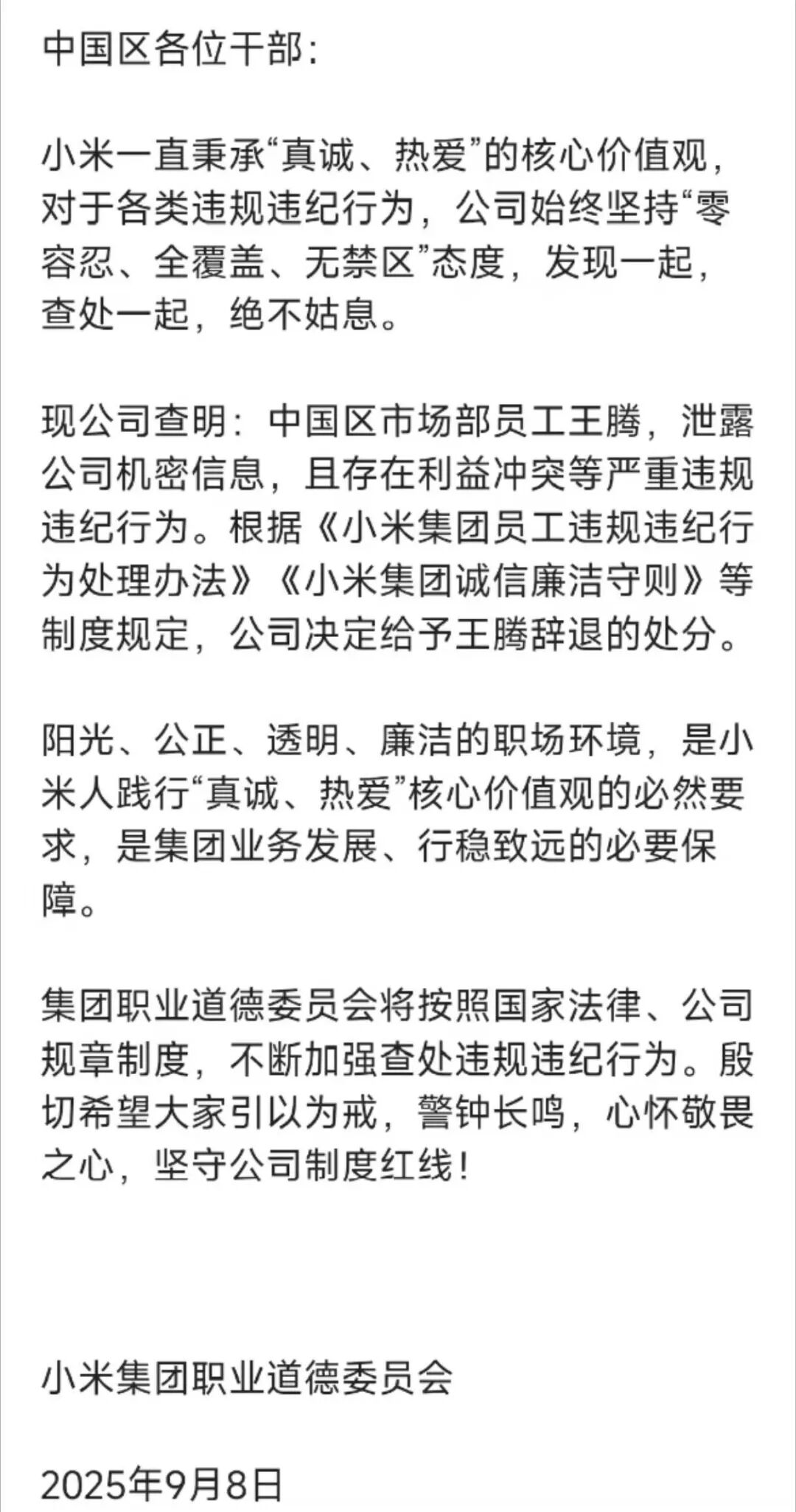
Wang Teng, general manager of Xiaomi’s China marketing department and head of the Redmi brand, has been dismissed for “serious violations” of company rules, the Chinese tech giant announced in an internal notice on September 8, 2025.
The company said Wang leaked confidential information and engaged in conflicts of interest, breaching internal policies. Xiaomi emphasized its “zero-tolerance” stance on misconduct and urged managers to treat the case as a warning and strictly adhere to company rules.
Later that evening, Wang issued an apology on Weibo, saying he accepted the consequences of his mistakes and expressed gratitude to Xiaomi founder Lei Jun and the company’s leadership for their support. He added that he would continue to support Xiaomi and Redmi, and planned to “take a short break before starting anew”.

As of press time, Wang’s Weibo account no longer displayed his previous verification as general manager of Xiaomi’s China marketing department and head of the Redmi brand.
The Rise and Fall of Wang Teng at Xiaomi – A Cautionary Tale of Talent, Trust, and Trade Secrets

I. The Rise of a Key Figure: Wang Teng’s Stellar Career at Xiaomi
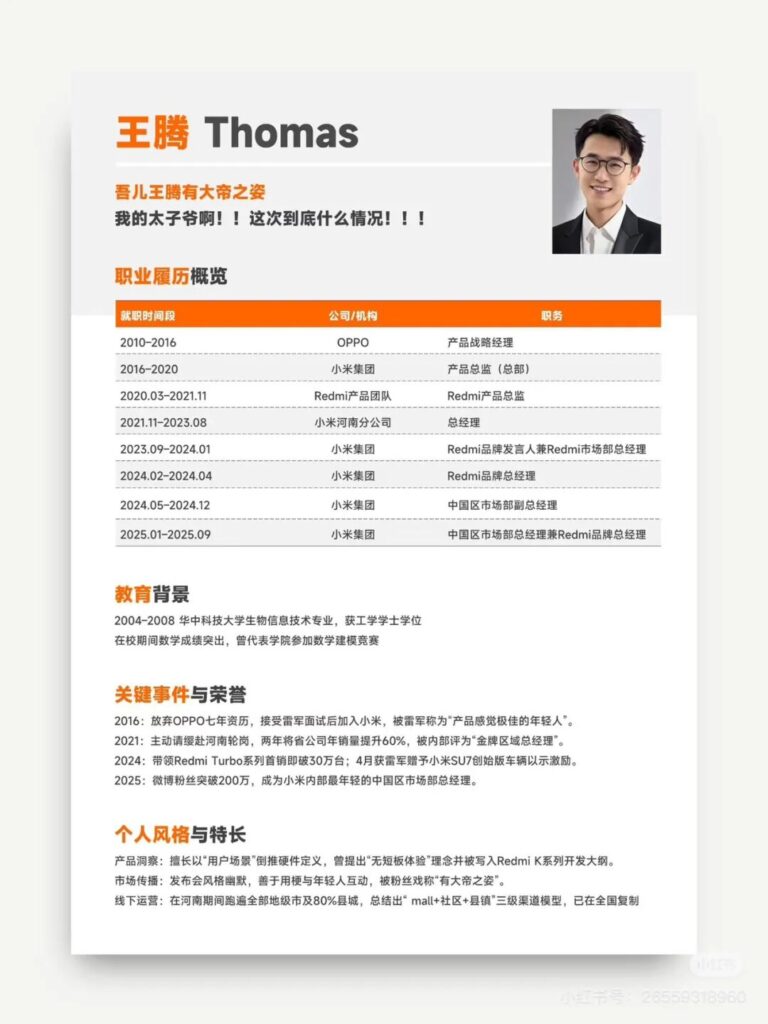
Before delving into the reasons behind the case of the Xiaomi Executive Fired Over Internal Leak – specifically Wang Teng – it is critical to understand his status and contributions at Xiaomi. His resume stands as a prime example of talent nurtured and promoted from within Xiaomi:
- A Benchmark for Product Managers: In 2016, Wang left OPPO (where he had worked for 7 years) to join Xiaomi after a personal interview with Lei Jun (Xiaomi’s founder). His sharp product intuition and market insight quickly gained recognition. The concept of “all-round user experience” he proposed was even incorporated into the development guidelines for the Redmi K series smartphones—becoming one of the key cornerstones of the series’ success.
- A Frontline Hero Delivering Results: In 2021, Wang volunteered for a rotational assignment as General Manager of Xiaomi’s Henan Branch (a province in central China). He immersed himself in on-the-ground operations, visiting all prefecture-level cities and 80% of counties in Henan. There, he developed an efficient “three-tiered channel model (mall + community stores + town-level outlets)”. Within two years, he boosted the branch’s annual sales by 60% and won the title of “Gold Award-winning Regional General Manager”—proving he understood not just products, but also market execution.
- Helmsman of Brand and Marketing: Due to his outstanding performance, Wang was recalled to Xiaomi’s headquarters. He held roles including Redmi Brand Spokesperson and General Manager of the Marketing Department, eventually being promoted to General Manager of Xiaomi China’s Marketing Department and General Manager of the Redmi Brand—making him one of Xiaomi’s youngest core executives. Under his leadership, the Redmi Turbo series sold over 300,000 units on its first day of sales. With over 2 million followers on his personal Weibo (China’s leading social platform), Wang became a vital “down-to-earth, humorous brand advocate” for Xiaomi. In April 2024, Lei Jun personally gifted him a Xiaomi SU7 Founding Edition (Xiaomi’s flagship electric vehicle)—a strong sign of recognition for his work.
This track record makes clear: Wang was no ordinary executive. He was a trusted, high-achieving “core team member” deeply appreciated by Lei Jun, with a rapidly rising career at Xiaomi.
II. The focus of the incident of “Xiaomi Executive Fired Over Internal Leak” lies in: why “leaking secrets” is an uncrossable red line for Xiaomi.
According to Xiaomi’s internal announcement, the direct reason for Wang’s dismissal was “suspected of leaking the company’s trade secrets”. For a tech firm like Xiaomi—operating in cutthroat markets—“confidentiality” is the lifeline of its survival and growth.
- Fierce Industry Competition: The smartphone and automotive industries have long product cycles. If core information (e.g., product pricing, launch timelines, key technical specifications) is leaked in advance, competitors can quickly adjust their strategies to launch targeted countermeasures. This could render huge marketing investments useless and even directly hurt product sales.
- Xiaomi’s Culture of Confidentiality: Lei Jun has always attached great importance to information security. Internal information at Xiaomi is strictly classified by level, and any transgression is seen as a severe betrayal of the company’s interests. Prior to Wang’s case, Xiaomi had already taken strict action against multiple employees for leaking secrets.
- Sensitivity of the Current Era: As the leader of Xiaomi China’s Marketing Department and the Redmi Brand, Wang had full access to future plans for Xiaomi’s smartphones. More importantly, he may have also known marketing strategies for the Xiaomi SU7 (the company’s EV). At this critical juncture—when Xiaomi is “all-in” on its automotive business and facing immense competition in smartphones—any leak could lead to incalculable losses.
III. Potential Reasons and In-Depth Analysis Behind the Incident of “Xiaomi Executive Fired Over Internal Leak”
While the official announcement only mentions “leaking secrets”, external analysts believe the incident may not be a simple innocent mistake.
- The Double-Edged Sword of His Social Media Persona: Wang maintained an active presence on social media, interacting frequently with fans. This open approach boosted brand visibility, but it also increased the risk of inadvertently revealing undisclosed information during interactions. It’s possible that a casual attempt to “tease upcoming products” or engage fans crossed Xiaomi’s established boundaries.
- Strict Compliance Procedures: Large companies like Xiaomi have rigorous standard operating procedures (SOPs) for market launches. Any external communication must go through multiple rounds of review (e.g., legal, PR departments). As a senior executive, Wang should have understood compliance better than anyone. If he intentionally bypassed these procedures to share information privately, the offense would be far more serious.
- A Warning for Internal Management: Some analysts argue that Xiaomi’s “difficult decision to discipline a high-performing executive” reflects the management’s zero tolerance for compliance violations. No matter how high one’s position or how great their contributions, violating the company’s core interests will result in severe punishment. This incident sends a strong warning to all employees, reaffirming the seriousness of Xiaomi’s rules.
IV. Conclusions and Takeaways from the Incident of “Xiaomi Executive Fired Over Internal Leak”
Wang Teng’s dismissal is a tragic conflict between personal achievement and professional ethics, open engagement and trade secret protection. It serves as a powerful reminder for all professionals—especially senior executives:
- Trade secrets are a critical boundary that must not be crossed, especially in highly competitive industries.
- A clear line must exist between personal influence and corporate rules: Even “star executives” cannot place themselves above the company’s systems.
- Trust, once broken, is hard to rebuild: All past achievements and fame can become insignificant in the face of a principled mistake.
Wang Teng’s journey at Xiaomi was once a textbook example of career advancement. But his ending has become a cautionary tale about compliance and risk. His story is regrettable, but it once again proves a truth of modern corporate governance: systems take precedence over personal relationships, and rules above all else.